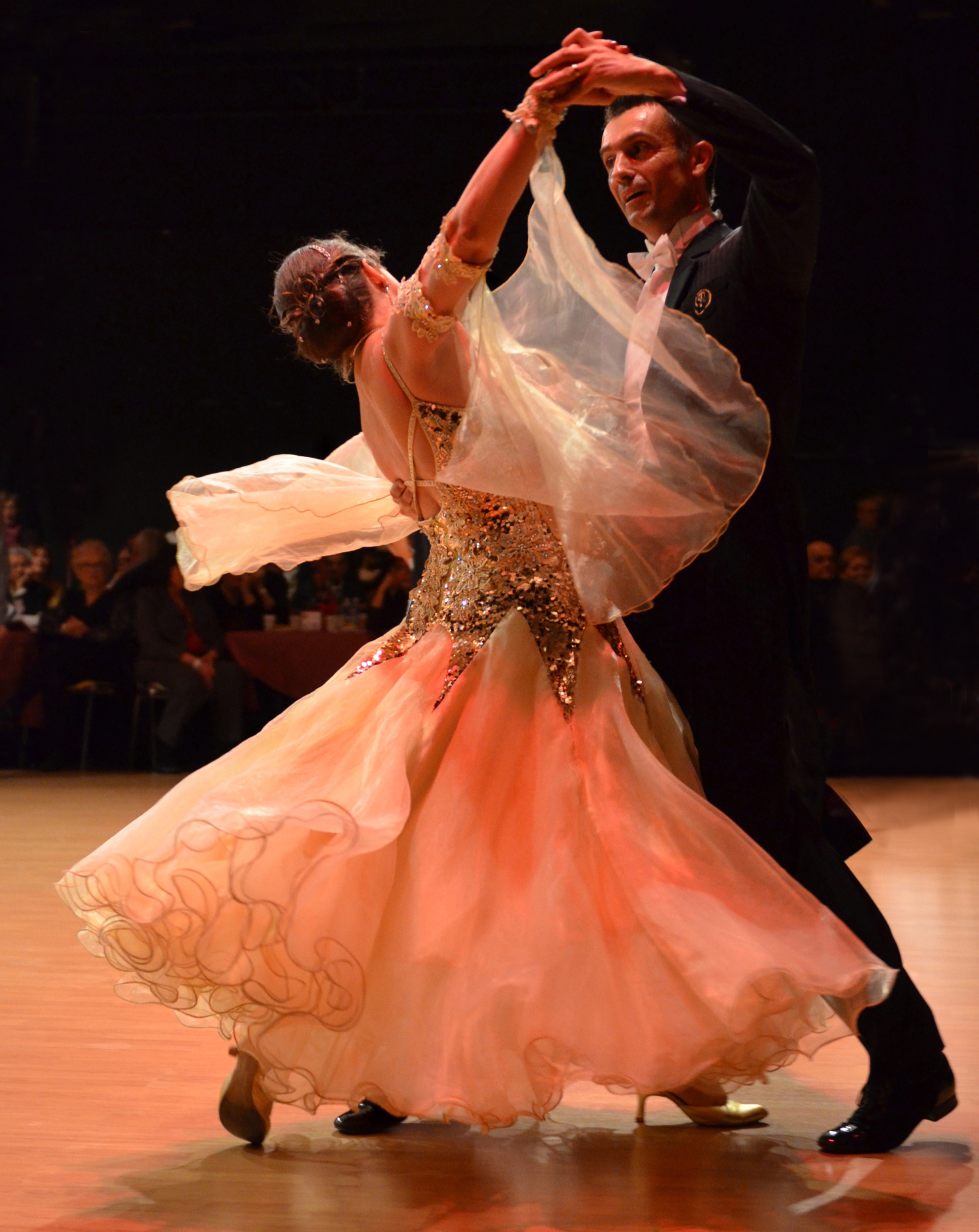
In social partner dancing, every dance style falls into one of these two categories: dances that travel the floor and dances that don’t. In all the traveling dances, dance partners seek to make a circuit around the perimeter of the dance floor. In the non-traveling dances (sometimes called “spot” dances), you stay in one general area of the dance floor.

This can be a tricky distinction because some of the traveling dances migrate slowly, and some of the “spot” dances move around quite a bit. You may also associate these distinctions with Smooth vs. Rhythm dances in American style, or Standard vs. Latin dances in International style. But these categories don’t quite capture the specific, functional distinction that I’m addressing with this article. It is an important distinction that I think is much more helpful in learning to use your dances effectively, and it is a distinction that is frequently overlooked or misunderstood by new learners of these styles. Knowing about the special demands of traveling dances (vs. all the others) will help you use the dancefloor more effectively and keep these dances in better perspective as you’re learning.
All social dances offer opportunities for taking up more space or less space on the dancefloor. All dances can be expanded and contracted, depending on the size and shape of your dancefloor. As you learn more and more advanced steps, many dances give you the flexibility to cross to other zones of the room. While you may be traveling—in a certain sense—in all your dances, the “traveling dances” as a category have specific structural and functional demands that govern their mode of movement.

A traveling dance is one that moves around the dance floor on an imaginary “race track” going counter-clockwise. The fundamental action of these dances propels the dancers forward along this track, called the “line of dance.” While they might have some dance moves designed to “tread water” in one spot for the purposes of traffic-management, the motivating thrust of these dances is to aspire always to resuming forward travel along the line of dance.
The term “line of dance” can be a bit misleading, as it calls to mind a single, narrow pathway. That’s why I prefer to conceptualize the traveling dances as moving along a “race track,” because then you can imagine multiple “lines” or lanes of dancing, as well as the necessity to change lanes as you dance. You might start out in the “middle lane” as you dance, but because of traffic, you have to move to the outer lane, or the inner lane; often you may be switching amongst these lanes regularly as you make your way down the floor, just like driving on a congested multi-lane highway. The most important quality of traveling our “line of dance” is the same as driving on any highway: direction! You must always be moving forward in the same direction as the cars (dancers!) around you.
The Smooth dances and the Standard dances are, indeed, all traveling dances. Waltz, Tango, Fox Trot, Viennese Waltz and Quickstep all share the common aim of traveling along our “race track” line of dance. But not all Rhythm or Latin dances belong to the “everything else” or non-traveling dances category. Paso Doble travels and Samba is ideally a traveling dance (though it is often treated as a “spot” dance on the beginner level, and people sometimes get stuck in “spot” mode in this dance). Several “Specialty Dances” also belong to the traveling category; most of the Country & Western Dances—including Progressive Two Step, Texas Two Step, Country Waltz and Country Shuffle—travel, as well as our de facto Pittsburgh favorite: Polka! Argentine Tango CAN be danced in a very small area like a “spot” dance, but given enough space to roam it will travel along the line of dance with a little more leisure than the Smooth/Standard/Country dances, taking time to ebb and flow with cool intricate movements that rotate into themselves before expanding outward again. Appreciated for its lively, big-band-era flavor, Peabody is a traveling cousin of Fox Trot that is still taught and danced in some ballroom communities; the New Vogue dances, inspired by Smooth/Standard and practiced primarily in Australia, also travel around the floor.
All the remaining dances—”everything else”—do not travel in the “race track” manner. If these dances move enough to cross a significant area of the floor, it is simply because one pattern or amalgamation takes them in a particular direction. These significantly moving patterns might travel in a line, in a square, or in something resembling a large circle or polygon, but they can be aimed anywhere and do not need to observe the directional progression of the line of dance. The leader simply must make sure there is space to execute one of these wider-spanning patterns before initiating it. Leaders may find it helpful to have a rough mental picture of the size and shape of the pattern, as well as the average amount of space it takes up on the dancefloor.

It is important to understand that the navigational demands of the traveling dances do make them harder. Many beginner leaders (and sometimes advanced ones, too!) are frustrated when their Waltz or Fox Trot feels full of mistakes, fits and starts. Are you asking yourself: “Why isn’t my Waltz in better shape?” especially compared to your Cha Cha, Rumba or Swing? If your “everything else” dances are feeling pretty good and your traveling dances are still hit and miss, you are not alone! The traveling dances will ALWAYS be harder than “spot” dances. It’s because the traveling dances require you to do all the same things (e.g. keep timing, remember your steps, lead clearly, execute style and technique, etc.) as any other social dance, but ON TOP of all that, you also have to navigate your “race track”; because the traveling dances always require this additional layer of attention, they will always present a greater challenge. You’re not crazy! Traveling dances ARE more difficult, and the navigational dimension makes them more demanding at every level, for beginners and advanced dancers.
In this way, leading traveling dances is sort of like driving a car (or your other favorite motorized vehicles). As leader, you have to think about what’s happening now, but also what’s happening up the road. You have to think in extended linear space, how the dance elements you lead in the moment will play out over the next several feet of dance floor space—your “race track”—as you’re dancing. You can’t just do any dance pattern that jumps to mind; you have to understand where you can do it, how you need to be oriented to the dance floor and how it will travel you. This sounds like a lot to keep track of, but a good personal lesson teacher will make sure that you learn the navigational aspects of any new dance pattern. Traveling elements, patterns and amalgamations all have their particulars and subtleties, and that’s why it’s useful to have a teacher who knows you well and can present these facets to you in terms that match your learning style. I have taught entire lessons and classes just on navigational theory…
But here are two main things you should know about every element, pattern or amalgamation you do in the traveling dances.
FIRST: Make sure you know where you should be oriented in relation to the dance floor at the beginning of the pattern. The way you’re pointed when you start a move will have a huge effect on where you end up. If you’re facing the wrong direction when you start, it’s the difference between success and chaos! There are lots of subtle gradations in room alignments for traveling dances, but the two you’ll use more often are diagonal center (aiming slightly left, toward the center of the floor), and diagonal wall (angled slightly right, or toward the outer edge of the floor, i.e. the wall around the room). If you want a more detailed, technical discussion on alignments with a handy diagram, check out this page: https://www.dancecentral.info/ballroom/resources/alignment-diagram

Suffice to say, if you’re not facing in the correct direction when you start, your pattern will meander off in a direction that does not follow the line of dance, and may put you in a sticky traffic situation, or off the edge of the floor where there’s no room left to dance. Learn your starting room alignments for each new pattern or element. If you’re going back in your mind, trying to sort through the elements you already know, a solid generalization is that left-turning elements usually start diagonal center, and right-turning elements usually start diagonal wall. But there are some quirky exceptions out there, so if you’re not sure, please consult your personal teacher on your next lesson.
SECOND: Have a general idea of how your pattern is designed to travel. This advice may not be relevant to you, depending on the story playing out in your brain as you dance. If you’re an element-based leader, going from one smaller unit (i.e. elements that are only a measure or two long) to the next, then you are the one stringing together your dance on the fly, like beads on a necklace. Presumably you are considering where you are on the line of dance with each new element you choose. If, however, you have learned lengthier patterns—groupings of elements as a choreographed piece or a syllabus-based pattern—you need to understand how the pattern travels in order to understand where and when to use it. Some longer patterns shape naturally to the line of dance, in which case, you can start them anywhere in the room. Some patterns are designed to travel straight and cannot be curved or bent, and in that instance you have to wait until you have an long open area of dance floor in front of you. Finally, some patterns are designed to fit around a corner, and are best deployed at the end of the long stretch because they will automatically carry you around the corner and into the next straightaway.
Of course, even having all these navigational guidelines in the front of your mind does not account for the unpredictable movements of your fellow dance floor citizens. Your best laid navigational plans can be thwarted by traffic; just like on the road, people cross in front of you and dancers get backed up like cars in a traffic jam. Leaders always need to have their “trouble steps” ready to be deployed at any time; sometimes, that even means stopping to wait for the traffic to clear. Just because you’re an advanced dancer doesn’t mean you always have an artful solution to every instance of dancefloor gridlock; sometimes you just have to stop in the most aesthetically pleasing way that you can. But that’s a worst-case scenario. Many times, even in the tightest dance floor situations, you can at least do some manner of sidewards trouble step. Hesitations in Waltz (or Viennese Waltz), slow sways in Fox Trot, or an extra long, or two-sided foot draw in Tango will usually do the trick, even if you can’t immediately move forward.

While most of the navigational burden does rest on the leader’s shoulders, that does not mean that followers bear no responsibility for the success of traveling dances. Every dance is, ultimately, a partnership. There are three things followers should do to aid the leader in navigating our “race track” line of dance. ONE: Be the rearview mirror. Even the most skilled leader does not have a 360 degree view of the dance floor at all times. I have witnessed a number of collisions and near-misses where two leaders careened directly toward each other backwards! Giving a cautionary signal, like a shoulder-squeeze, when you see danger approaching can be a huge help to your leader. TWO: Understand the line of dance. Just because you’re not the one making the decisions about what patterns to do and where doesn’t mean you can check your phone when the teacher starts talking about navigational theory. Knowing how the line of dance works lets you approach your role in the partnership with navigational awareness. Knowing where YOU are facing in relation to the line of dance helps you “guess”-timate how you’ll be stepping next. If your back is pointed down the line of dance, chances are you’re going to be stepping backward; if you are facing down the line of dance, chances are you’re going to be stepping forward. Having an accurate estimate of where you’ll be stepping next helps you fulfill the third big follower’s responsibility in traveling dances… MOVE! Yes, you are following, but you’re also powering the movement of traveling dances down the floor. One of my dance coaches described the lead/follow partnership dynamics in the traveling dances by saying: “The leader is the driver; the follower is the motor!” Your leader may be steering, pushing the gas pedal and hitting the brakes, but you two won’t be going anywhere if you stall out, so make sure you move with elegant power and consistency so that you both have a smooth ride!

It is important to remember that your traveling dances present extra challenges and considerations that all the other non-traveling dances do not. If you’re foggy on what these are or how to use them, please consult your personal teacher; you might benefit from a tune-up to your “navigational systems” on your lesson. In the meantime, cut yourself a break if your traveling dances seem more difficult than “everything else”; they’re supposed to be harder. And frame your expectations when you dance them to realize that your “game plans” will not always happen as easily as they do in “spot” dances where traffic and direction are not such a big consideration.
DANCE MORE WITH DANCE FRIENDS
Get Started with Lessons
Browse our Events Feed
Subscribe to our Newsletter
Follow us on FACEBOOK
Follow us on INSTAGRAM
Subscribe on YOUTUBE
TEXT us 412-712-7131
EMAIL us PittsburghDance@gmail.com
Leave a Reply