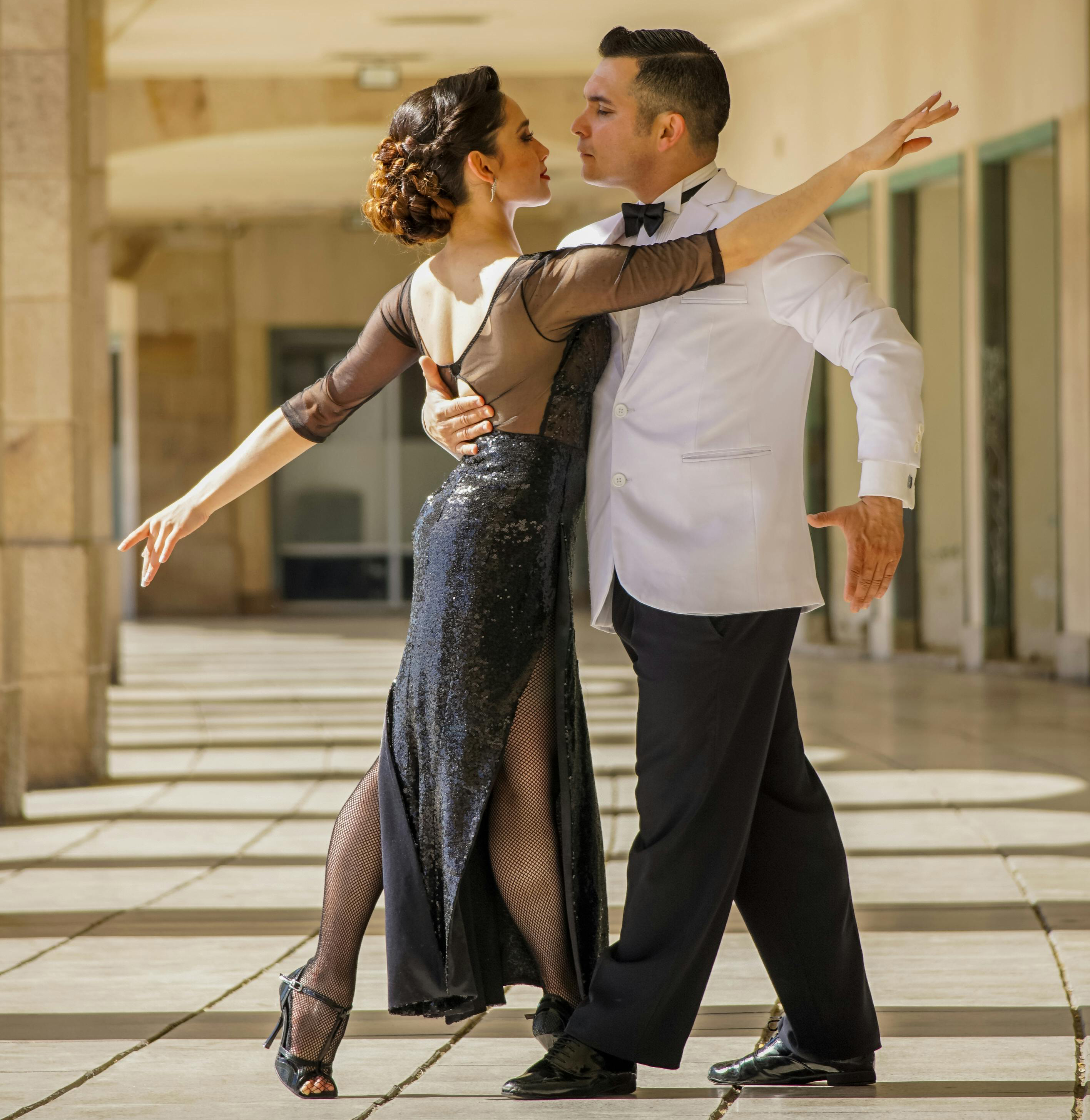
Want the short answer first?
All of them.
The ones you dance with a partner, of course. But yes, people who call themselves “ballroom dancers” stake a claim to ALL the social partner dances. That’s because people who do ballroom dancing as a hobby don’t put exclusions or limits on the number of dances that they do (see my post “What is ballroom dancing?” for a more thorough discussion of what in means to do ballroom dancing as a hobby). Sometimes people who don’t do ballroom dancing think that the term refers to the Smooth/Standard dances, the ones that sweep elegantly across the room like Waltz and Fox Trot; occasionally the term “ballroom” is used in this context, but much more often, the term “ballroom dancing” refers generally to the hobby of people who do several different social partner dance styles.

This doesn’t mean that EVERY ballroom dancer knows EVERY partner dance. Obviously, there are limits on time (alas, most ballroom dancers have to work for a living doing something non-dance-related) and taste (not every dance style appeals to every dancer). But for the people who enjoy this hobby, the Ballroom Dance Buffet offers up any partner dance style, from which participants pick and choose.
If you show up to a ballroom dance, you’re going to encounter a different constellation of dances depending on who is hosting and what the crowd favorites are. A ballroom DJ has got to start somewhere, though, right? There is a core group of dances around which the hobby of ballroom dancing is built; in its most narrow, technical definition—which is formalized by competitions, exhibitions and studios that prioritize these categories—the core ballroom dances are:
In INTERNATIONAL STANDARD:
Waltz
Tango
Fox Trot
Viennese Waltz
Quickstep
In INTERNATIONAL LATIN:
ChaChaCha
Rumba
Jive
Samba
Paso Doble
In AMERICAN SMOOTH:
Waltz
Tango
Fox Trot
Viennese Waltz
In AMERICAN RHYTHM:
Cha Cha
Rumba
East Coast Swing
Bolero
Mambo

Clearly there’s a lot of overlap between International and American (the differences between these two categories is a conversation for another day!). The short version is: there are lots of similarities and subtle, but important differences. For the purposes of understanding the hobby we call “ballroom dancing,” at most social events, your International Waltz dancers will share the floor with American Waltz dancers for the same Waltz song. And obviously some dances are more popular than others, based on their showing up in both categories. Everyone loves Cha Cha (Cha? inclusion of third “cha” notwithstanding), but it is rare to encounter Paso Doble outside a competition. Despite these core dances taking center stage, most ballroom competitions and exhibitions will also afford opportunities to perform a wide array of “specialty dances,” which include the club dances you know and love!
Most ballroom social DJ’s are generous with the inclusion of these “specialty” dances. The actual distribution of dancing will, of course, depend on what any particular DJ selects for the predicted audience at any particular event. When I have hosted ballroom socials, my playlists have been at least 1/3 specialty dances, sometimes more. I compiled the following list of specialty dances with an attempt to reflect the most-often-played at the top of the list, with less-played toward the end. This ranking is entirely non-scientific and based solely on my experiences creating playlists and attending ballroom socials locally in the Pittsburgh area.
SPECIALTY DANCES POPULAR AT BALLROOM SOCIALS
Hustle
Salsa
West Coast Swing
Nightclub Two Step
Bachata
Merengue
Country Two Step
Argentine Tango
Polka

Of course some events will play songs for dances not on this list, simply because they are popular within that particular community of social dancers (check out some Shag the next time you visit the Carolinas). The frequency with which any of these dances are played will also depend on the event and its attendees. And just because a dance comes from the “specialty” list, doesn’t mean it gets a lower priority than dances on the ballroom list. In fact, many specialty dances are MORE popular at ballroom dancing events. At many ballroom events, you may likely hear more Hustles than Sambas, more Salsa and West Coast than Mambo or Quickstep, and any one of these Specialty dances is much more likely to pop up at a social than Paso Doble (which is often regarded as the most theatrical and LEAST social of the ballroom dances).
As I mentioned in my article “What is ballroom dancing?” social ballroom dance events will often have songs that do “double duty” for multiple dances. The versatility of knowing a bunch of dances means that ballroom hobbyists can “cover their bases” in a number of different ways without having to know ALL the dances listed in this article. People who know Argentine Tango, may choose to dance it to an American or International Tango song. Dancers who don’t know Bachata know they can dance American Rumba to most Bachata songs. International Rumba and Bolero work to a lot of the same music. Lindy Hop enthusiasts can bust out their favorite moves to many East Coast Swing songs. When a Quickstep comes on, at least a few people usually cluster in the center of the floor to dance Jitterbug.
Suffice to say, you certainly don’t need to know ALL the ballroom dances if you want to dance a lot at a ballroom social. While, technically, you can dance any 4-count dance to any 4-count song, you will probably find it aesthetically perplexing to dance Salsa to a Fox Trot song. A good ballroom teacher will be able to diversify your repertoire with a small collection of dances to cover a majority of the songs played at a ballroom social; as your comfort grows with this smaller selection of dances, you’ll be able to get a sense for just how many dances you might eventually want to learn. Contrary to what most people think, you actually learn to dance faster when you learn multiple dances because there are so many interrelated patterns and skills; each new dance you learn enhances your abilities in every other dance you do.
Don’t forget to check out our concurrent article, “What is ballroom dancing?” here on the Dance Friends Blog.
DANCE MORE WITH DANCE FRIENDS
Get Started with Lessons
Browse our Events Feed
Subscribe to our Newsletter
Follow us on FACEBOOK
Follow us on INSTAGRAM
TEXT us 412-712-7131
EMAIL us PittsburghDance@gmail.com
Leave a Reply