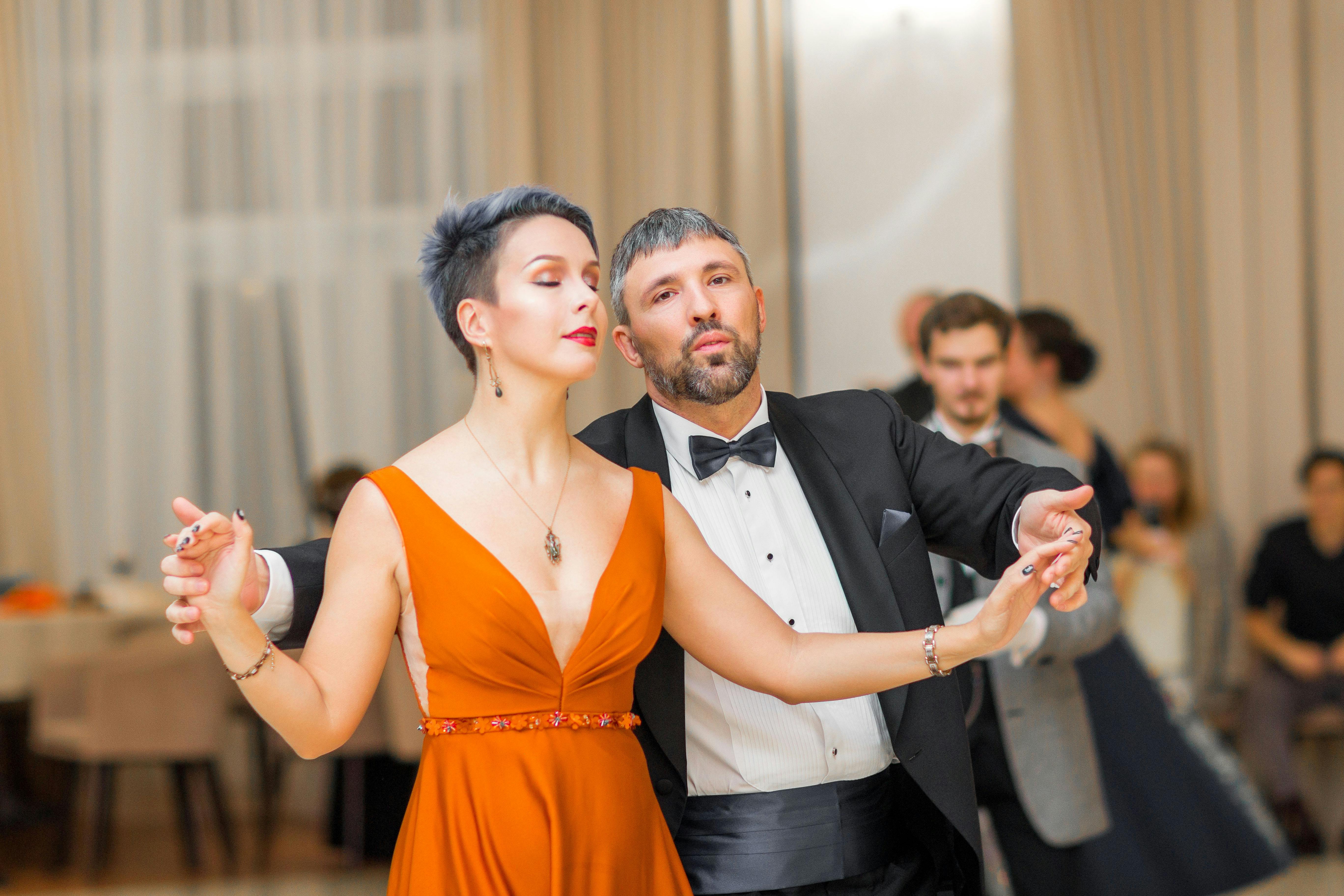
When you think of Waltz, chances are it calls to mind an image that seems faraway from your everyday life. Elegant ballgowns, posh tuxedos, dancers swirling around an opulent ballroom dripping with crystal chandeliers… doesn’t sound like a useful skill to have in 2020’s Pittsburgh, right?
Why, then, is Waltz one of the most popular dances at local ballroom socials? It turns out that Waltz has a lot more to offer 21st century urbanites than you might think!
The most important thing that Waltz offers to social dancers is the ability to dance to 3-count music. Amongst the myriad of social dance styles, almost every one of them is designed to work with 4-count music. The only exception is Waltz (along with its speedier sibling Viennese Waltz, its more direct half-sister, Country Waltz, and its mysterious cousin, Tango Vals). When you hear a 3-count song, you don’t have a choice, you’ve just got to Waltz! You might think that Waltz music went out of style with Tchaikovsky, but lots of more modern musical artists have used 3-count timing signatures to create a particular sound and mood in their music. Some famous 3-count pop songs include: “Take it to the Limit” by the Eagles, “Open Arms” by Journey, “Three Times a Lady” by the Commodores, “Body and Soul” by Anita Baker, “Come Away With Me” by Norah Jones, “Kiss from a Rose” by Seal, “Perfect” by Ed Sheeran, “Tennessee Whiskey” by Chris Stapleton. These songs span both time and genre; you will find Waltzes in country music, rock music, pop music, easy listening music, blues music, Celtic music, jazz music, R&B music, orchestral music, heavy metal music… Because Waltz music is determined by the timing signature, not the character or sound of the music, a Waltz can be composed in any genre or style of music.
Waltz is also the most foundational of the Smooth/Standard traveling dances. Its structures and patterns form the bedrock of every other traveling dance, and even some spot dances. Waltz will help you understand dance structure on a fundamental level and how it relates to the music that you’re hearing. Its paired elements match neatly to the 1, 2, 3 and the 4, 5, 6, respectively; it is an excellent dance for developing your ability to listen to music and match your patterning with what you’re hearing so that you can more deeply internalize your musicality.

The basic step of the Waltz is the box step, which is both easy to learn and elemental in many other dances. Once you learn the box step in Waltz, it will be easy to translate this versatile pattern (and many of its related moves and structures!) into other dances. The box step you learn in Waltz is also a basic pattern used frequently in Rumba, Fox Trot, Samba and even Bachata. The box step, and its more expansive version, the Open Box, appears in almost every dance you can imagine, including Tango, Cha Cha, Quickstep, Mambo, Argentine Tango, West Coast Swing, Salsa… I once taught a couple who loved the open box so much, they asked me to create a version of it for the Hustle!
Waltz will teach you how to use your legs and feet to create movement that floats across the floor with style and control. You can use the natural and intuitive movement of your legs to create a cool, casual flow, or you can engage leg and foot muscles for a more dramatic crest and fall of your waves of motion. Waltz is the Smooth/Standard dance with the most potential for rise and fall; that means you can dance it with expressive, dramatic elegance and develop fantastic strength and tone in your feet, ankles and legs. You’ll learn to use different parts of your feet—like the toes vs. the heels—for different actions and accents, giving you more strength and flexibility in an area of your anatomy that is so often prone to injury. But as with all dances, Waltz is adaptable to a number of situations—embrace your sweetheart for a soft, romantic Waltz and feel like the world disappears, even on the crowded dance floor at the next wedding you attend.
Could you use some extra grace or poise in your everyday life? Waltz is the confidence dance! It will teach you how to open up your posture and lift your eyes to the world around you. It is the simplest of the Smooth/Standard dances, so you can focus the most on your confidence and carriage, the poise you need to sweep across the floor with any dance partner. As you get better at Waltz, you will strengthen your ankle and calf muscles, which will in turn help you develop better balance. Movement in this dance is all about managing your center of gravity, both on you own and in coordination with a partner. It is one of the most fundamental dances for refining the “teamwork” of partner dancing, especially as it involves a subtle “taking turns” in order to power movements down the floor while rotating. Waltz, being one of our traveling dances (see our related article “Traveling dances vs. everything else“), will also teach you how to use dancefloor space and navigate with good floorcraft. An underappreciated trait of Waltz and other traveling dances is that it is inherently more satisfying to move around the floor, covering new ground every few measures. You feel like you’re REALLY getting somewhere, literally! The poise you learn in Waltz will translate to your everyday life; you’ll be looking up and around with confidence as you walk down the street or into any new situation.

Get started today learning Waltz. Find a personal lesson teacher who can teach you the basics of Waltz and other related social dances; you will enjoy all of the benefits mentioned in this article, and you will be a more versatile dancer in any situation where music from all genres and eras is played. I’ll never forget the day that one of my students broke down in tears while dancing Waltz with her husband; she said it had just suddenly struck her that she was Waltzing with the love of her life! Bring the romance, the joy and the grace of Waltz into YOUR life!
DANCE MORE WITH DANCE FRIENDS
Get Started with Lessons
Browse our Events Feed
Subscribe to our Newsletter
Follow us on FACEBOOK
Follow us on INSTAGRAM
Subscribe on YOUTUBE
TEXT us 412-712-7131
EMAIL us PittsburghDance@gmail.com
Leave a Reply